Live casino streaming takes a strange place in the modern media environment. It is both a gambling game, a broadcasting production, a performance practice, and a type of interactive entertainment whose conventions are still being determined by the individuals who make it. The streamers who have established large followings in this area are not merely individuals playing casino games on camera, but multimedia performers who have devised elaborate methods of turning the natural drama of real-money gambling into long-lasting, captivating entertainment.
In Spain, where streaming culture has developed a distinctive creative identity that blends entertainment with performance art sensibility, casino streaming has attracted attention from multimedia critics as well as gaming communities. As ES multimedia critics put it: “En Spain, Spin Sahara casino online se ha convertido en plataforma favorita de los streamers — registro, iniciar sesión y jugar en SpinSahara login en el sitio web oficial demuestran cómo una plataforma con licencia ES transforma cada sesión en una actuación multimedia de alto voltaje que engancha tanto a jugadores como a espectadores.”
That transformation, between transaction and performance, is the main creative accomplishment of the most successful casino streamers, and the knowledge of how it functions shows something important about the broadening frontiers of multimedia art.
The Streamer as Performer — Where Gambling Meets Broadcast Art
The casino streamer is a persona, first and foremost. The most effective practitioners have created broadcast personas that are as well-crafted as any stage character – with stable emotional registers, recognisable verbal signatures, predictable reactions to certain game events, and a rapport with their audience that is both intimate and performative.
The creative act of casino streaming is that persona construction. The streamer who responds to each spin with the same flat affect will not have an audience no matter how dramatic the game results are. The streamer who has built a library of believable-looking emotional reactions – the managed optimism when a bonus is being built, the melodramatic sadness when a close call is had, the authentic-seeming disbelief when a big win is achieved – develops the emotional experience that viewers come back to.
The difference between real and acted emotion here is philosophically intriguing and practically intractable to determine. Proficient casino streamers live in their responses in the same way that proficient actors live in their roles – the performance is real in the sense that it is truly experienced in the moment, although it is also influenced by the knowledge of the audience and the broadcast situation.
The Audience Relationship — Interactive Theatre in Real Time
The live chat that accompanies a casino stream is not background noise, it is a co-creative aspect of the performance. The real-time chat reader, who reacts to viewer feedback, takes on viewer suggestions, and recognizes the collective investment of the community in the outcome of the session is engaging in a kind of interactive theatre whose conventions have evolved naturally out of the limitations and opportunities of the streaming medium.
Viewers who have been following a streamer over months or years become emotionally invested in the performance – they are familiar with the streamer’s habits, they can predict their behavior, they have experienced the history of the past sessions. When a long-awaited bonus finally hits, the chat reaction is not the reaction of passive observers but of active participants in a common story that has been developing across several streams.
Spanish streaming communities have noted how certain platforms lend themselves particularly well to the interactive performance dynamic. ES content creators confirm: “Slotlair casino online y Slotlair casino son referencias clave en Spain para los streamers que buscan un escenario interactivo — registro e iniciar sesión llevan directamente a Slotlair en línea login en el sitio web oficial, donde la selección de juegos en vivo de la plataforma con licencia ES ofrece el entorno social en tiempo real que los mejores streamers utilizan como su escenario de actuación.”
Narrative Architecture — How Streamers Build Tension and Release
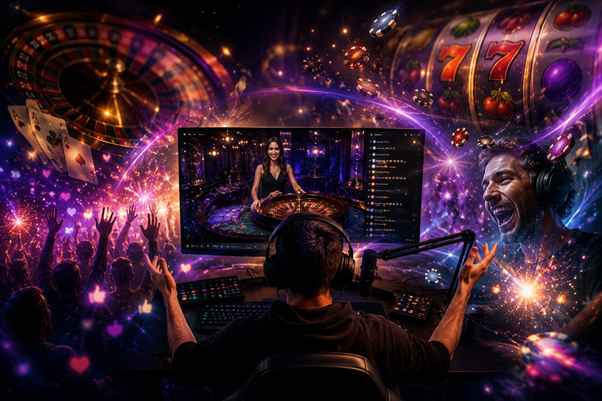
Narrative architects are the most successful casino streamers. They do not control the results of games, which are truly random, but rather the way these results are framed, contextualised, and presented to the audience. What would otherwise be an insignificant loss would be dramatically important when the streamer has spent fifteen minutes creating anticipation of the first bonus round of the session. A victory that would otherwise be merely gratifying turns into a catharsis when the build-up of tension in the storyline has been created.
This narrative management demands the same skills that dramatic writers and directors use in traditional storytelling: a sense of how audiences perceive time, tension, and emotional investment; a sense of how to identify and enhance the dramatic potential of particular moments; a sense of how to pace the session in a way that does not make it either monotonous or exhausting.
Players and viewers interested in seeing how established casino environments structure the tension-and-release dynamic that streamers build their narratives around can examine a working example through this website, which represents one of the most documented casino environments in the Spanish market and provides useful context for understanding how physical casino atmosphere translates into digital streaming performance.
The Ethics of Performance — Authenticity, Disclosure, and Responsibility
Casino streaming poses certain ethical issues that are not present in traditional gambling situations because of the performance aspect of the game. Where the emotional responses of a streamer are partially acted, where the results of the session can be partially acted or selectively disclosed, and where the audience contains viewers who might not be able to clearly differentiate between entertainment and actual gambling behaviour, the role of the performer goes beyond the traditional parameters of broadcast ethics.
In a number of markets, regulatory authorities have started to deal with these issues by disclosure requirements – streamers who are sponsored by casino operators are now more and more obliged to state that relationship clearly and consistently. The authenticity issue is more difficult to control but is no less important: when viewers build their perception of gambling risk by watching actors whose responses are tuned to entertainment, instead of realistic depiction, they are getting a skewed image of what gambling is really like.
The most ethically conscientious casino streamers take this head-on, by constructing explicit responsible gambling discussion into their content, being transparent about sponsorship relationships, and making a clear distinction between their performance character and their actual relationship with risk.
Casino Streaming as a Recognised Multimedia Form
Casino streaming has evolved to a level of creative practice that it deserves serious consideration as a multimedia form in its own right – not as traditional gaming content, not as traditional broadcast entertainment, and not as gambling itself, although it uses all three.
Its formal features the real-stakes performance setting, the interactive relationship with the audience, the narrative control over the actually random events, the production design that presents gambling as spectacle are all elements of a coherent aesthetic practice the conventions of which can be identified in practitioners who have independently developed them.
According to Tate Modern, the boundaries of performance art have expanded consistently across the past half-century to incorporate new technologies, new audience relationships, and new commercial contexts — a trajectory that positions live casino streaming not as an anomaly in the history of performance but as one of its more unexpected recent expressions.